

Menu
Available Technologies
Noise Reduction through Enhanced Sensitivity in Atomic Force Microscopy
Integrating the new “Optical Lever 2.1” system into the AFM enhances sensitivity by 2.2×and reduces the displacement-equivalent noise density to one-third.
Background
An atomic force microscope (AFM) achieves nanometer-scale resolution by detecting the minute deflection of a cantilever-mounted probe that functions as a force sensor. AFM commonly uses the optical lever method, in which a laser beam measures cantilever displacement. Because smaller laser spots on the photodiode improve sensitivity and reduce noise, minimizing spot size is critical. However, conventional optical systems lack spot-size control, and beam divergence before reaching the photodiode limits sufficient reduction.
Description and Advantages
Compared with commonly used optical lever systems -including Optical Lever 1.1 and the objective lens -based Optical Lever 2.0, which achieve a typical sensitivity of 114 mV/nm with a 1-mW red laser (displacement-equivalent noise density: 9.9 fm/√Hz) -the new Optical Lever 2.1 delivers markedly superior performance. It attains a sensitivity of 254 mV/nm and reduces the displacement-equivalent noise density to 3.1 fm/√Hz, representing a 2.2-fold increase in sensitivity and a threefold reduction in noise (Fig. 2).
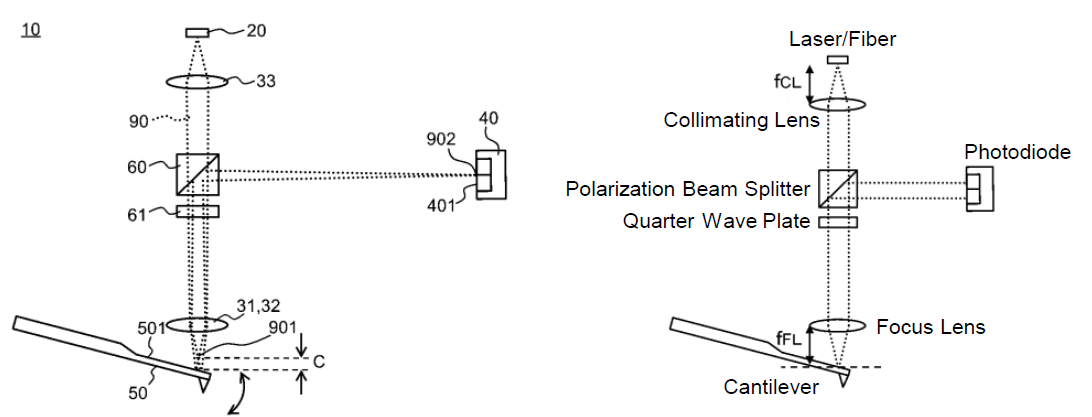 Fig.1 Optical Lever 2.1 of the Present Invention (left) and the Conventional Optical Lever 2.0 Optics (right)
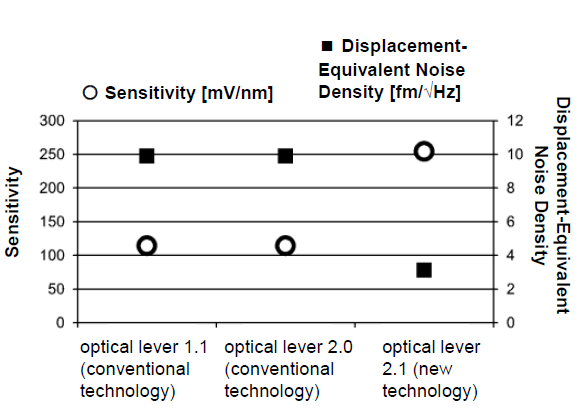
Fig.2 Comparison of Sensitivity and Displacement-Equivalent Noise Density
| Development Status |
Confirmed: Experimental sensitivity and noise performance match theoretical predictions |
|---|---|
| Offer | •Patent License •Option for Patent License •Collaborative Research |
| Related Links | View PDFView in Japanese |
Have you found what you were looking for?
- Interested in a particular research activity
- Cannot find the information
- Have questions on how to utilize research results
Feel free to contact us and get answers to your questions.
Inquiry- TLO-KYOTO
- Available Technologies
- Noise Reduction through Enhanced Sensitivity in Atomic Force Microscopy

3rd Floor, International Science
Innovation Building, Kyoto University
Yoshidahonmachi, Sakyo-ku, Kyoto
606-8501 JAPAN